
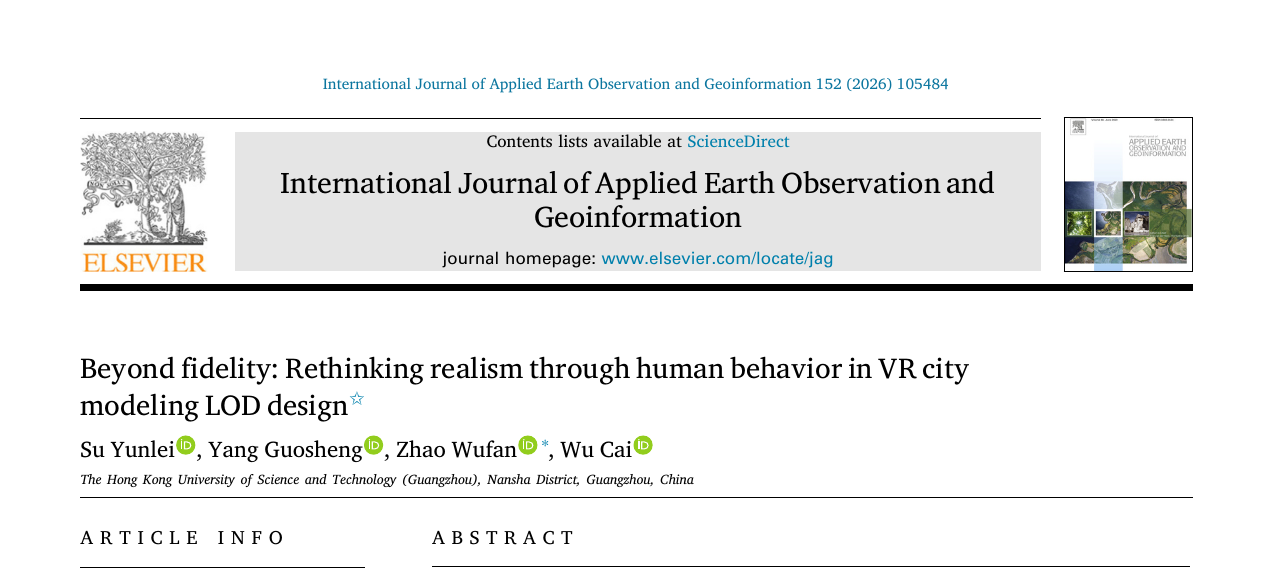
UMS’s latest research, published in International Journal of Applied Earth Observation and Geoinformation, challenges a long-standing assumption in virtual city modeling: greater geometric or semantic complexity does not necessarily produce a more realistic human experience.
The paper, “Beyond fidelity: Rethinking realism through human behavior in VR city modeling LOD design,” was authored by Yunlei Su, Guosheng Yang, Wufan Zhao, and Cai Wu. It is available at https://doi.org/10.1016/j.jag.2026.105484.
Using eye-tracking experiments conducted in Guangzhou’s Xianfeng Community, the study develops a perception-driven Level of Detail (LOD) framework organized around three dimensions: Feature Complexity, Appearance, and Semantics. It evaluates how different combinations of these dimensions shape gaze behavior and perceptual coherence in virtual urban environments.
The results show that a configuration combining High Feature Complexity, Mid Appearance, and Low Semantics (H-M-L) most closely aligns with real-world gaze distribution while optimizing both global gaze patterns and perceptual coherence. The findings suggest that human-centered urban digital twins should prioritize perceptual validity rather than simply maximizing visual detail.
The study also introduces an open-source tool for analyzing gaze behavior in urban VR environments, providing a scalable approach for immersive urban design research and multi-source urban decision-making. The tool and supporting resources are available at https://github.com/suyunlei/Perception-LOD.
This work was conducted by researchers affiliated with the Urban Governance and Design Thrust at The Hong Kong University of Science and Technology (Guangzhou).