
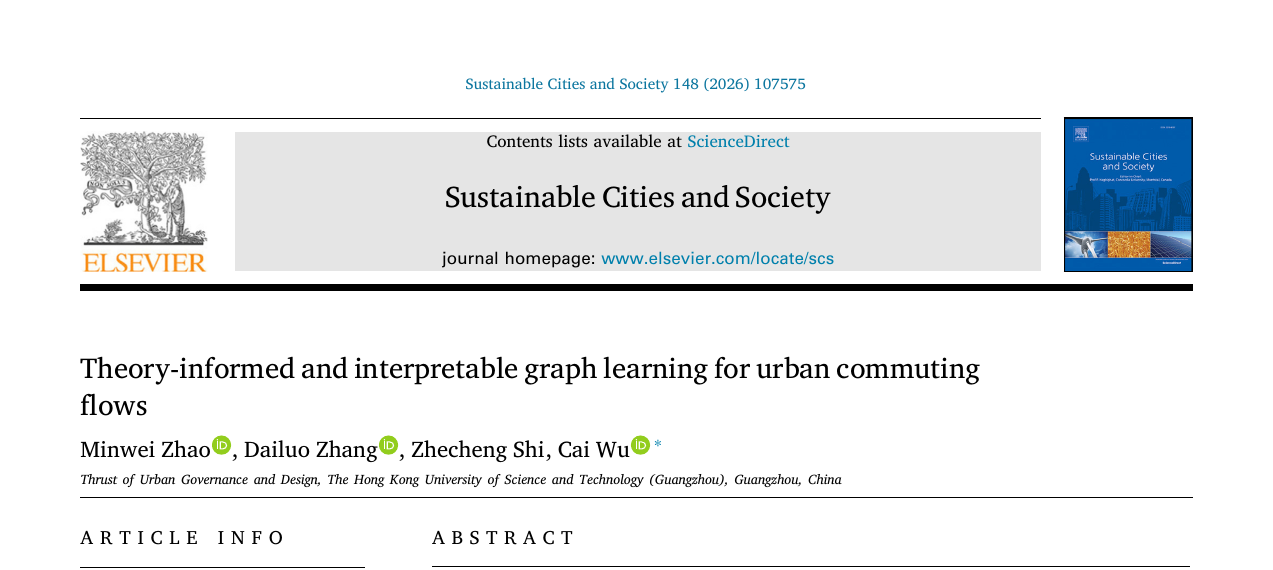
UMS’s latest research, published in Sustainable Cities and Society, introduces a theory-informed and interpretable graph learning framework for predicting urban commuting flows while preserving established geographic principles.
The paper, “Theory-informed and interpretable graph learning for urban commuting flows,” was authored by Minwei Zhao, Dailuo Zhang, Zhecheng Shi, and Cai Wu. It is available at https://doi.org/10.1016/j.scs.2026.107575.
The study presents PIG-GNN, a Physics-Informed Gravity Graph Neural Network that combines a dual-tower origin and destination encoder with an origin-destination interaction graph. The framework embeds adaptive constraints based on distance decay, Zipf scaling, and flow distribution, allowing it to retain the flexibility of deep learning while remaining consistent with spatial interaction theory.
Evaluated using England’s Home-to-Work commuting flows, PIG-GNN outperforms classical gravity and radiation models, tree-based regressors, and recent deep learning baselines. Its predictions also remain consistent with observed scaling laws, improving both accuracy and geographic plausibility.
The model reveals a bimodal flow structure that distinguishes high-frequency intra-urban trips from gravity-dominated inter-urban connections. This regime-aware interpretation provides useful evidence for sustainable mobility planning, network design, and multi-scale urban analysis.
This work was conducted by researchers affiliated with the Urban Governance and Design Thrust at The Hong Kong University of Science and Technology (Guangzhou).