
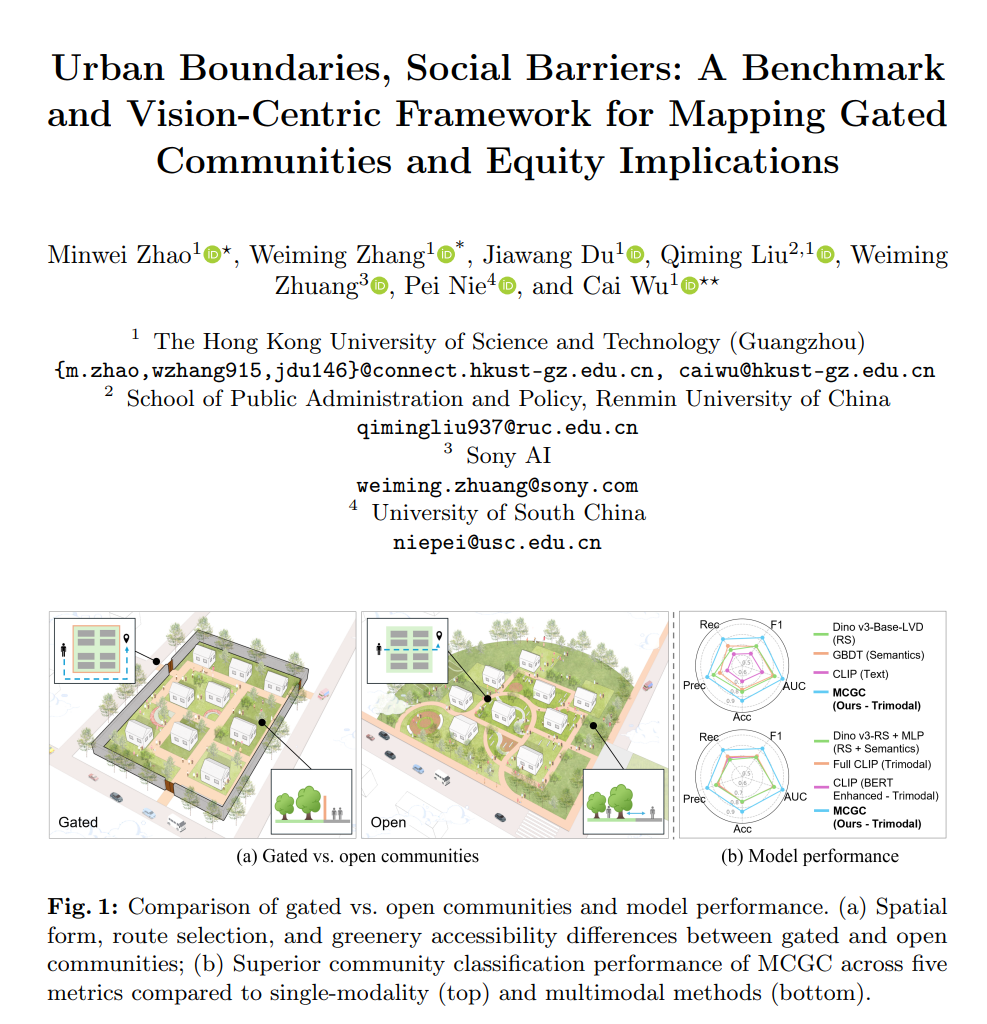
UMS’s latest research, published at the European Conference on Computer Vision (ECCV 2026), introduces a large-scale multimodal benchmark and vision-centric framework for mapping gated communities and examining their implications for urban accessibility and spatial equity.
The paper, “Urban Boundaries, Social Barriers: A Benchmark and Vision-Centric Framework for Mapping Gated Communities and Equity Implications,” was authored by Minwei Zhao, Weiming Zhang, Jiawang Du, Qiming Liu, Weiming Zhuang, Pei Nie, and Cai Wu. It is available in the Springer ECCV 2026 proceedings.
The study introduces GBA-GCs, a metropolitan-scale benchmark covering 37,444 residential communities across nine mainland cities of China’s Greater Bay Area. Each community is represented through aligned boundary information, high-resolution satellite imagery, Chinese semantic information, and structured spatial attributes, enabling gated/open community recognition at a scale difficult to achieve through conventional field surveys.
Built on this benchmark, the authors propose MCGC (Multimodal Classifier for Gated Community), a vision-centric multimodal framework that explicitly models the spatial contrast between the inside and outside of community boundaries while integrating visual, textual, and structured information. On the expert-annotated Guangzhou benchmark, MCGC achieves an average F1 score of 0.848 and AUC of 0.917, outperforming the unimodal and multimodal baselines evaluated in the study.
Beyond community recognition, the study applies the resulting maps to urban analysis, illustrating how gated boundaries can alter estimates of pedestrian connectivity, access to public services, green-space exposure, and housing-related spatial differentiation. The work therefore connects computer vision with urban morphology and spatial equity research, providing both a reusable benchmark and a computational foundation for studying how physical urban boundaries shape everyday accessibility.
This work was conducted by researchers affiliated with The Hong Kong University of Science and Technology (Guangzhou), Renmin University of China, Sony AI, and the University of South China, with contributions from the Urban Morphology Studio at HKUST(GZ).