
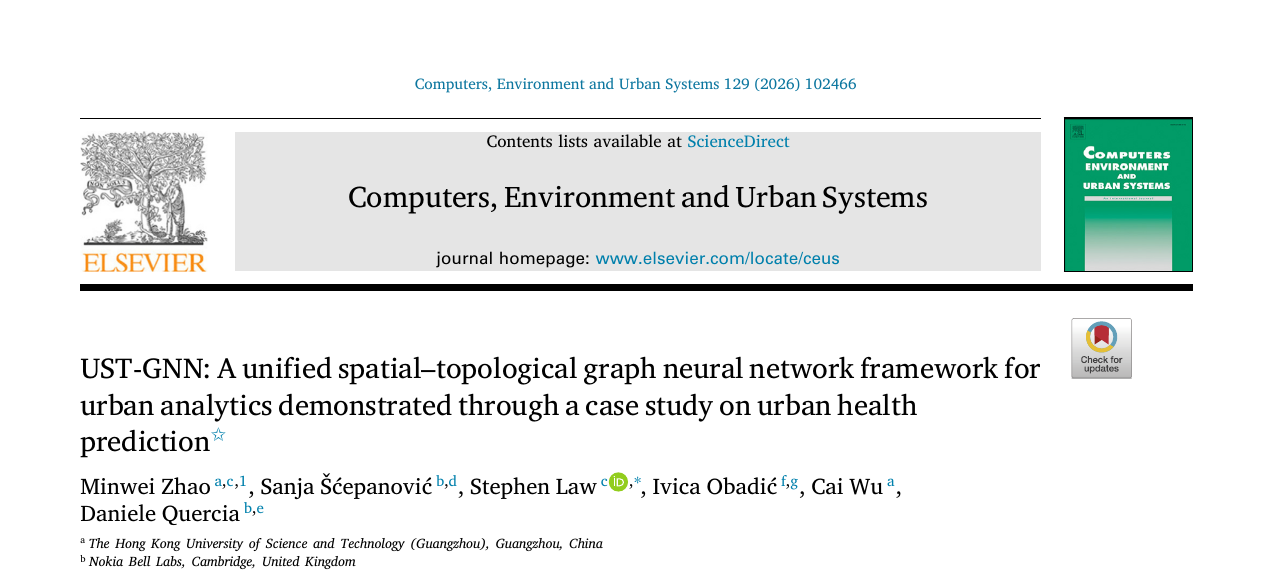
UMS’s latest research, published in Computers, Environment and Urban Systems, introduces UST-GNN, a unified spatial-topological graph neural network framework designed to capture the complex relationships among urban environments, population characteristics, spatial structure, and health outcomes.
The paper, “UST-GNN: A unified spatial-topological graph neural network framework for urban analytics demonstrated through a case study on urban health prediction,” was authored by Minwei Zhao, Sanja Šćepanović, Stephen Law, Ivica Obadić, Cai Wu, and Daniele Quercia. It is available at https://doi.org/10.1016/j.compenvurbsys.2026.102466.
UST-GNN integrates neighborhood connectivity, heterogeneous urban features, and positional and locational embeddings within a single graph representation. Using the MedSAT dataset, which contains more than 150 environmental and socio-demographic variables and six prescription outcomes across 4,835 neighborhoods in Greater London, the framework models spatial and topological dependencies that are often overlooked by conventional statistical and machine learning approaches.
Under strict spatial cross-validation, UST-GNN improves out-of-sample R-squared performance by 8.4-13.2% compared with strong statistical, geographically enhanced, and graph machine learning baselines. The study also introduces a lightweight principal-component module that interprets learned node embeddings geographically and connects them to policy-relevant urban characteristics.
The findings demonstrate the value of graph-based spatial machine learning for urban health analytics, environmental inequality assessment, and evidence-based policy. UST-GNN also provides a unified GeoAI pipeline that can support urban digital twin workflows for scenario testing, monitoring, and data-informed decision-making.
This work brought together researchers from The Hong Kong University of Science and Technology (Guangzhou), Nokia Bell Labs, University College London, the University of Oxford, Politecnico di Torino, the Technical University of Munich, and the Munich Center for Machine Learning.